TRACERAdaptive Multi-Robot Social Navigation via Joint Human-Response Prediction and Interaction-Aware Replanning
Narrated overview, 2 min 50 s: joint response prediction, closed loop replanning, and comparisons on SocialGym2 and CrowdSimPlus.
Joint plans shape human responses. Executed interactions update beliefs. Updated beliefs guide the next plan.
What this paper does
Multi-robot navigation in human-shared spaces is inherently interactive: coordinated robot motions influence how nearby entities respond, while those responses provide valuable information for subsequent robot decisions. However, existing methods typically address action-conditioned prediction, multi-robot planning, or online adaptation separately, and therefore lack a unified mechanism for modeling joint robot-entity interactions and adapting future decisions from executed interaction outcomes.
To address this gap, we propose TRACER, a bi-directional receding-horizon framework that closes the loop between prediction and adaptation. TRACER evaluates candidate (i.e., alternative feasible future motion plans for the robot team) trajectories using a per-entity probabilistic response model that separates individual-robot effects from non-additive pairwise interactions; after executing the selected trajectory prefix, it updates persistent identity-bound beliefs over latent response modes using the synchronized observed responses.
These updated beliefs then guide subsequent candidate evaluation under probabilistic safety and response-aware cost criteria. Experiments show that (i) TRACER more accurately captures non-additive multi-robot interaction effects than a capacity-matched additive predictor, (ii) persistent identity-consistent evidence improves response prediction and downstream replanning, and (iii) the complete TRACER framework improves collision-free completion over an independent-robot baseline on the SocialGym2 multi-robot social-navigation benchmark.
Prediction, memory and planning in one loop
Compare genuinely joint plans
Each person’s response is conditioned on the whole team trajectory, split into individual robot effects and non-additive pairwise interactions.
Keep evidence on the right person
Identity bound beliefs over latent response modes carry what one interaction revealed into later replanning windows.
Plan with safety and response in mind
Candidates pass robot to robot feasibility and response aware chance constraints, then are ranked by task, safety and response costs.
Run it on a laptop
The CPU demo trains a small response model on generated data and runs seven decision windows. No dataset or GPU needed.
A receding horizon loop with memory
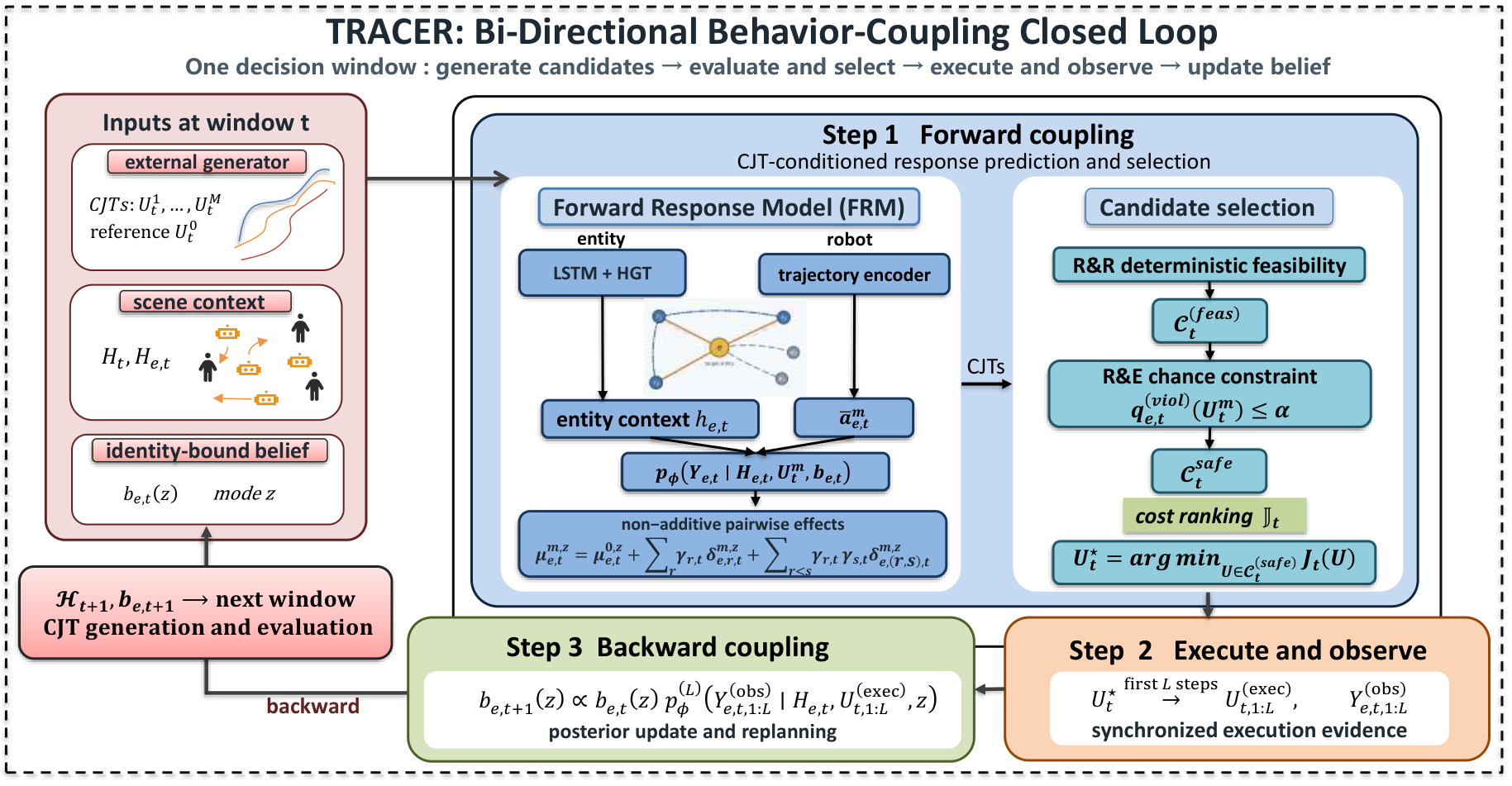
TRACER predicts joint action responses, executes a short prefix, updates identity bound beliefs from the observed responses, and replans.
Predict and select
Condition each human response on the full team trajectory: a reference term, individual effects and a non-additive pairwise residual. Pick a feasible candidate.
Execute and observe
Execute a synchronized prefix of the chosen plan and observe how each person actually responds.
Update and replan
Bind each response to its identity, update the latent mode belief, and carry that evidence into the next window.
Measured against matched baselines
lower pair effect RMSE than a capacity matched additive predictor, from 0.451 to 0.343
collision free completion on SocialGym2, up from 22.5% for GoAlone
paired SocialGym2 episodes behind the closed loop comparison
The SocialGym2 comparison is against GoAlone. It does not establish that every component ablation is worse. Controlled ungated replanning, conditional safety gate attribution, development scenes and later external checks have separate interpretations in the result index.
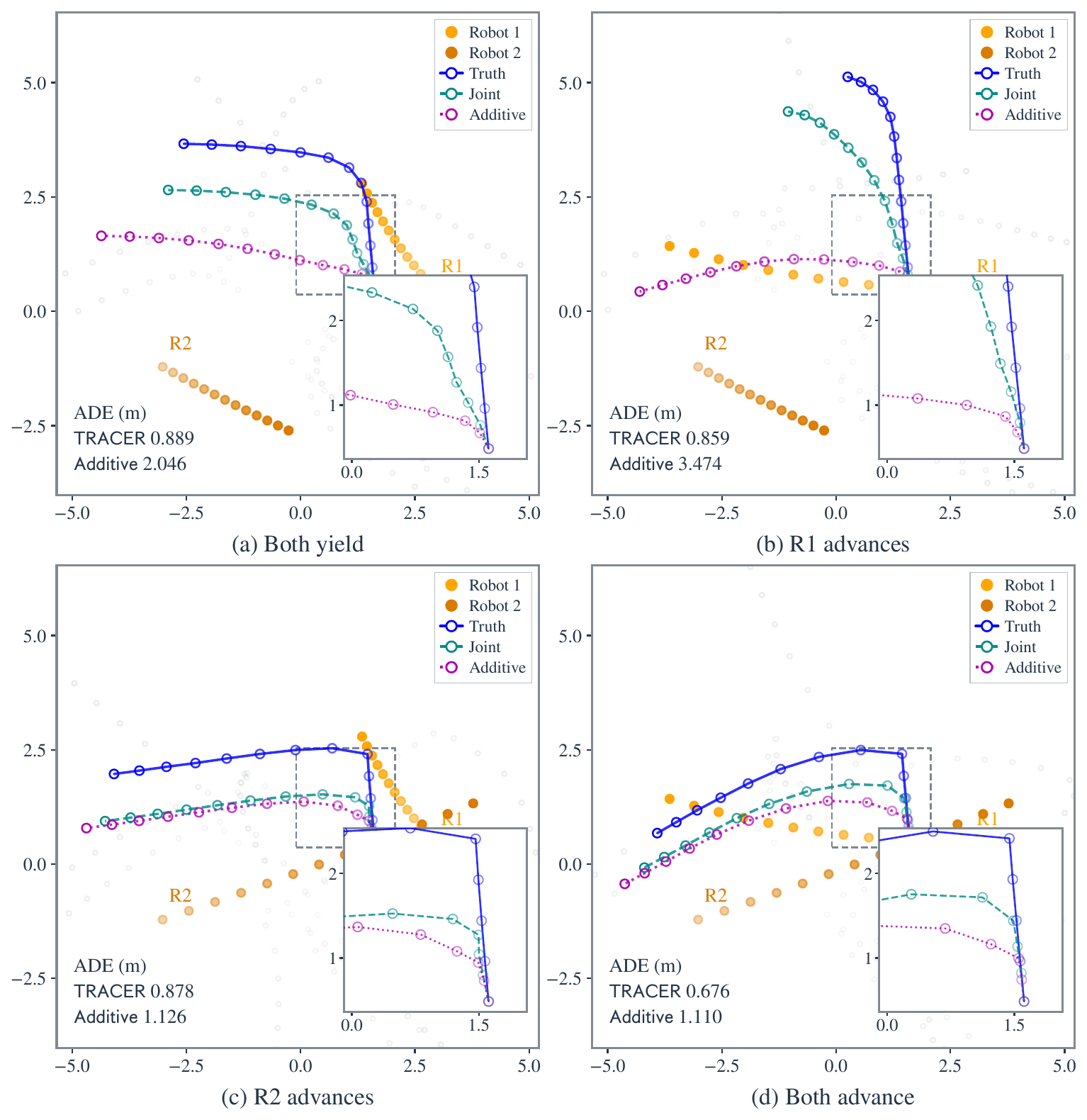
Predicted human trajectory under four robot action combinations: truth (blue), joint prediction (teal) and an additive predictor (magenta), with ADE per case.
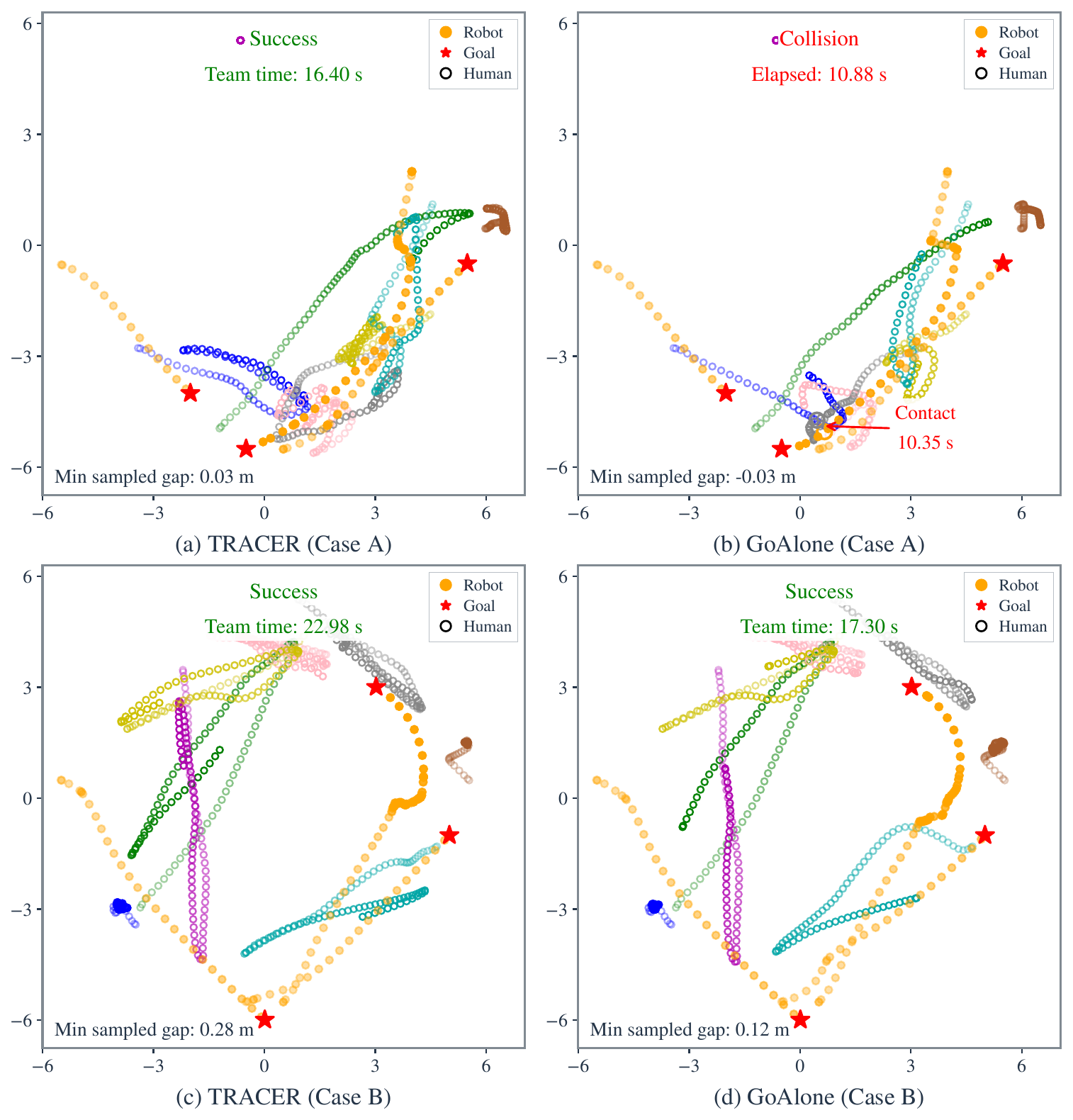
TRACER (left) against GoAlone (right). In Case A GoAlone ends in a collision while TRACER succeeds. Both succeed in Case B.
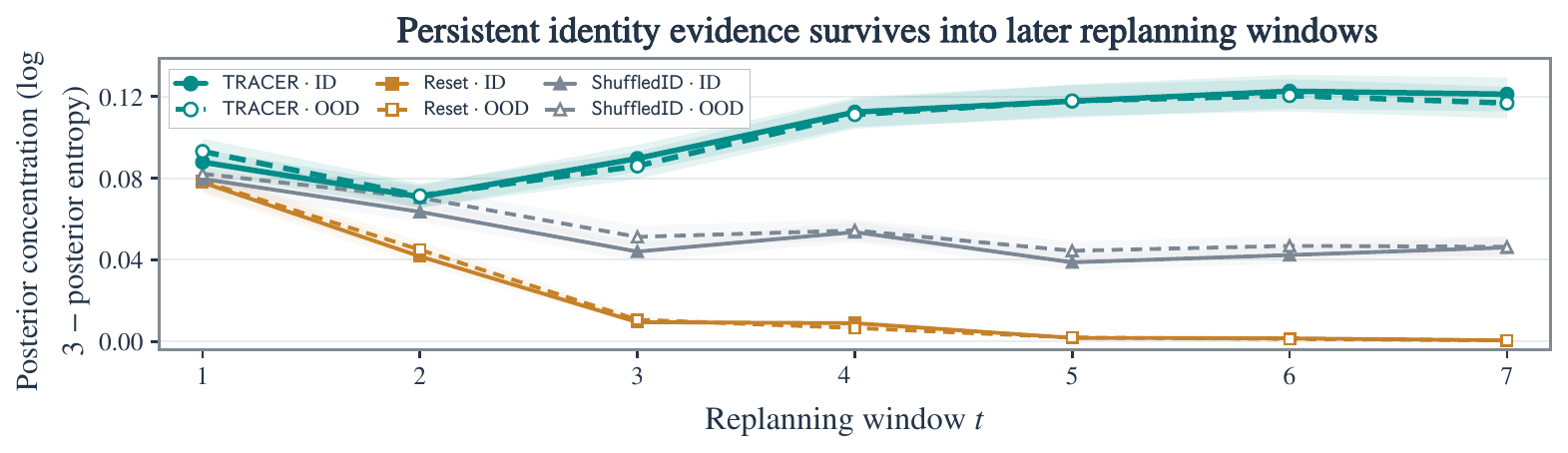
Across seven replanning windows TRACER keeps its posterior concentration, while Reset and ShuffledID variants lose it, in both ID and OOD settings.
Run it yourself
A CPU demo trains a small response model on generated data and runs seven decision windows with persistent belief updates. No dataset or GPU needed.
git clone https://github.com/Larryhul/TRACER.git
cd TRACER
python -m pip install -e ".[dev]"
python -m tracer.demo --output outputs/demoBibTeX
@misc{tracer_manuscript,
  title = {TRACER: Adaptive Multi-Robot Social Navigation via Joint Human-Response Prediction and Interaction-Aware Replanning},
  author = {Hu, Lan and Liwang, Minghui and Zhu, Wenbo and Yi, Xinlei and Gong, Wei and Hong, Yiguang and Hosseinalipour, Seyyedali},
  year = {2026},
  eprint = {2609.18776},
  archivePrefix = {arXiv},
  primaryClass = {cs.RO},
  url = {https://arxiv.org/abs/2609.18776}
}